
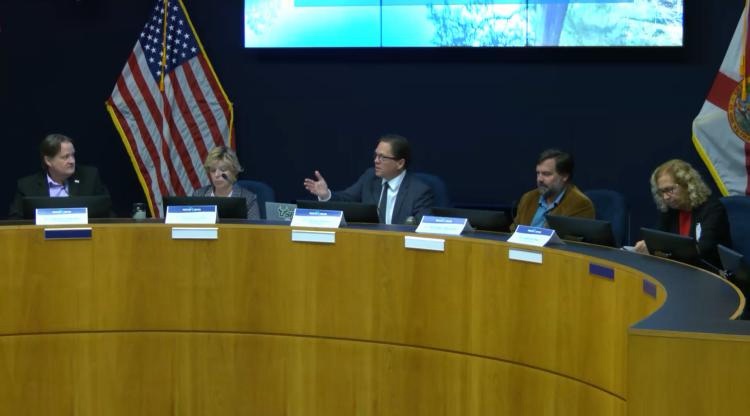
Florida has one of the most comprehensive state-level stormwater quality permitting programs in the United States.
Take that, Oklahoma.
As we’ve seen in this brief history, Florida continuously leads the nation in stormwater regulations. Why, exactly, is that? Do we love to torture our engineers? limit our development? are we secretly a far-left government in wolf’s clothing?
It is because we are susceptible.

More than any other state, we observe the consequences of our actions with water quality and runoff. Consider the pampered citizens of the other (read: lesser) states. They primarily reside in dendritic watersheds with plenty of elevation change, which means surface water runoff leaves quickly. Here, we swamp around in deranged terrain, where runoff sits and stagnates and steeps into the ground. In other places, many water quality issues get forced downstream and into the ocean; in Florida, we basically are either ocean-adjacent or closed and deranged (looking at you, central Florida).
Luckily, that makes many water quality issues bipartisan. Left to runoff’s own devices, algae blooms, fish die, and our tourism industry suffers.
After our 1980s stormwater rules, and up until 1995, projects required a Management and Storage of Surface Waters (MSSW) permit. This used presumptive criteria and required treatment and attenuation due to development and land cover change. Separately, a dredge-and-fill permit was often needed, especially as projects impacted wetlands and other surface waters (OSWs).
These permits eventually combined into our current comprehensive framework: the Environmental Resource Permit (ERP). For those in the business, this is the bedrock (or confining layer) of stormwater regulation.
Most forms of development and civil engineering projects require this permit, which is administered by each of the five WMDs and the FDEP. Even projects for the FDOT and municipalities must acquire these permits and show that they are meeting state stormwater requirements. For most of the remaining history, water quality requirements remained presumptive in nature, with each WMD setting design criteria for wet ponds, dry ponds, and other best management practices (BMPs).
For water quantity, or flood protection requirements, each WMD also sets requirements for attenuation of stormwater and ensuring no adverse impact occurs due to the projects. This approach is still handled at the WMD level and focuses on single frequency (100-year storm, or better defined as 1% annual chance), single duration (often 24-hour or 72-hour period of rainfall) storm criteria. Again, this ERP-level requirement is often more stringent than federal requirements, which in this case is FEMA. The intersection of ERP and FEMA regulations deserves its own article.
The net this permit throws is uniquely wide. Consider us development partners who want to build a strip mall in the middle of nowhere. No municipality limits, no MS4s, just us and god. In many states, there would be no requirements for stormwater aside from during construction, and if we impact documented floodplains (although, they may let us flood things a foot higher). The project would cause a small increase in flooding, and a minor worsening of water quality, but that isn’t a problem because there haven’t been visible problems. If it ain’t broke, don’t fix it.
In Florida, no one is safe.
This is the framework we still have in place today. Other permits are still needed for certain projects, however. A city may have stricter requirements that need to be met for urban development. The Army Corps of Engineers still regulate certain coastal and wetland impacts. FEMA, through a local community’s floodplain administrator, requires a study is done within a floodway.
The last key change to our current water quality requirements is the transition from presumptive criteria, administered and blessed by each WMD, to a numeric “net reduction” criteria set at the state level.
It is helpful to understand some political context when talking about this new rule change.
ERPs are proactive measures to make sure development doesn’t worsen our waters too much. In addition to that, there are state and federal watershed programs that are reactive in nature: finding observed water quality failures and prescribing measures to improve them. In 2009, a group of environmental organizations sued the EPA over Florida’s language about these watershed measures, which were narrative-based:
“…in no case shall nutrient concentrations of body of water be altered so as to cause an imbalance in natural populations of aquatic flora or fauna.” Chapter 62-302.530 (47)(b), Florida Administrative Code (FAC)
This triggered the state to develop specific nutrient standards for watersheds, which included total nitrogen (TN) and total phosphorus (TP). Although not directly stormwater related, this was a key step in what was to come.
In 2017-2018, we experienced harmful algal blooms. Red tide and blue-green algae bloomed across the state, killing fish, closing beaches, and causing respiratory distress to our coastal people.
In 2019, the Blue-Green Algae Task Force was created under the governor to study these problems, and one of their challenges was that stormwater systems, when designed under presumptive standards, may not meet their intended goals.
We now (2026) have finished our net nutrient reduction implementation and each new ERP must show quantitatively that its project reduces the TN and TP leaving its site by a certain extent. Additionally, maintenance requirements have become more stringent, in the hopes of preventing neglected ponds and infrastructure to contributing to our water quality problems.
As we look back through our history of stormwater regulations, we see gaps. Early on, we drained our wetlands and rushed water downstream, which we now spend billions to correct. We required development to build ponds, which we then found to underperform.
Understanding our problems, in hindsight, is an easy exercise, but what about the future? Are our regulations, now, enough?
Where are our blind spots, now?
Leave a Reply