
Florida Statute 373.016 (1): The waters in the state are among its basic resources. Such waters have not heretofore been conserved or fully controlled so as to realize their full beneficial use.
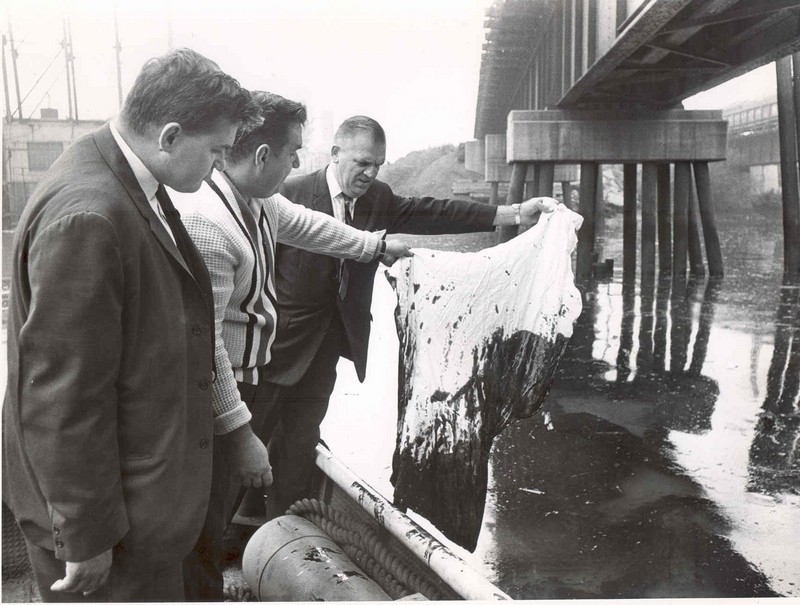
In 1970, the first Earth Day began on April 22nd, and a revolutionary environmental movement was in full swing. Oils spills, rivers catching on fire, smog surrounding larger cities, and off-tasting drinking water were among the most visceral effects of unregulated pollution in the United States. Alongside other civil movements, environmentalism was quickly affecting public policy.

Prior to this period, there was no strong enforcement or regulation around pollution being discharged into our waters. Wastewater, industrial waste, and more hazardous things were released in our waterways to disappear downstream. The toxicity of the Cuyahoga River at one point was even seen as a source of pride, symbolizing economic progress.
This may sound insane to us now, but for most of human civilization we used surface water bodies for sewage disposal. Rivers are the cheapest, most primordial form of municipal utilities: clean drinking water comes from upstream, while all your sewage and trash can float away downstream. The issue with this only becomes apparent when the scale and concentration explodes, both of which occurred in our modern industrial era.
President Nixon established the U.S. Environmental Protection Agency (EPA) by executive order in 1970. The Clean Water Act arrived in 1972, which finally regulated point source pollution, such as wastewater discharges. These important federal changes clearly influenced Florida’s regulatory evolution. Many mechanisms of the Clean Water Act are still important programs today, including:
- Section 402 – National Pollutant Discharge Elimination System (NPDES)
- Section 404 – Dredge and Fill Permitting (404 Permits)
- Section 303 – Water Quality Standards and Impaired Waters (303d Impaired Waters list)
- Total Maximum Daily Loads (TMDLs)
Florida, meanwhile, was making their own regulatory changes in the 1970’s due to this environmental movement. The year 1972 is sometimes called “the year of the environment” and one reason for this is the Florida Water Resources Act of 1972. This act created our five (originally six, which merged into five in 1975) Water Management Districts.

These WMDs (complete opposites of, and not to be confused with, weapons of mass destruction) were tasked with permitting consumptive water use, well construction, and management and storage of surface waters.
These programs really developed over the 1970s. With the Florida Environmental Reorganization Act of 1975, the Department of Environmental Regulation (DER) was created as a state agency that now had oversight of the WMDs. Programs for water supply planning and some water quality guidance was added to the WMD’s missions, including setting minimum flows and levels (i.e. waterbodies need at least a bit of water all the time) and additional wetland protections. In 1976, Florida voters approved a constitutional amendment allowing WMDs the authority to levy taxes up to 1 mill ($1 of ad valorem taxes per $1,000 of assessed property value), which gave the programs a huge influx of dedicated funding and fiscal muscle to carry out these tasks.
Comparing pre-1970 to post-1980 shows that this decade was a major revolution in surface water regulations. Development and industry now had a suite of new regulatory oversight for surface water quantity, point source discharges, wetland impacts, consumptive water usage, and floodplain storage losses.
Moving into the 1980s, these regulatory changes would only increase in scope and depth. In 1982, the first-in-the-nation stormwater treatment rule was adopted through F.A.C. 17-25 (now 62-25; 62-330). This now required a performance-based standard: systems must remove at least 80% annual Total Suspended Solids (TSS) from runoff after development. Exemptions existed for individual residences, agriculture activities, and other things, but most new developments now, for the first time, had to treat their stormwater runoff to a specific level.
Now, “80% TSS removal” is precise, but difficult to measure. Stormwater runoff can be murky and full of pollutants. Is your stormwater… 70% murky and full of pollutants, or 90%? It is a good thing for a rule to be quantitative and precise, but in recognition of that standard, a deterministic design method for common best management practices (BMPs) was offered. This is the beginning of a method for meeting stormwater quality standards that has been common in the industry for decades: presumptive water quality requirements. They vary slightly by WMD, but essentially they go like this: for retention systems, such as dry ponds where stormwater runoff infiltrates into the ground, if you retain 0.5-inches of runoff over your drainage area, it is presumed that you will remove at least 80% TSS; or, for wet ponds, where there is always water present, if you detain 1.0-inch of runoff over your drainage area.
“When a stormwater management system complies with rules establishing the design and performance criteria for such systems, there shall be a rebuttable presumption that the discharge from such systems will comply with State water quality standards. The Department and the Districts, pursuant to Section 373.418, F.S., shall, when adopting rules pertaining to stormwater management systems, specify design and performance criteria for new stormwater management systems which:
F.A.C. 62-40.432, Surface Water Management Regulation
- Achieve at least 80% reduction of the average annual load of pollutants that would
cause or contribute to violations of State water quality standards- Achieve at least 95% reduction of the average annual load of pollutants that would
cause or contribute to violations of State water quality standards in Outstanding
Florida Waters.”
Another key change in stormwater regulations occurred with the 1985 Growth Management Act, which required local governments to adopt a state-approved comprehensive plan. A key provision was concurrency, which said that public facilities (such as drainage and stormwater management, in addition to roads and other utilities) must be in place at the time of development, or built concurrently. This transformed the approach of stormwater management from reactive to proactive, linking stormwater infrastructure needs to growth and development. Additionally, the act required stormwater level-of-service (LOS) standards to be set by local governments, which meant deciding what level of flood protection they would plan towards.
Many cities and counties, as a result of this act, created their first stormwater master plans. The earliest stormwater utilities also began in 1986 with Tallahassee and Orlando: a clear response to new mandates and the resultant funding needs. Today, most local governments still do not have dedicated funding sources specific to stormwater needs, such as a utility fee. Instead, funding may come from a general fund or a public works budget.
“Stormwater management needs to be recognized as a true utility service on par with drinking water and wastewater utility services and it needs equitable and reliable funding, just like drinking water and wastewater utilities.“
Evaluating Stormwater Infrastructure Funding and Financing, March 2020 – US EPA EFAB Task Force Report
As we are wrapping up these major changes in our regulatory framework from the ’70s and ’80s, it is clear that Florida was leading the nation in stormwater management. The last important piece of these decades involves the CWA again and its 1987 amendments. These amendments to the CWA established the Municipal Separate Storm Sewer System (MS4) permitting program, which is the first time that stormwater discharges from urban areas were subject to federal regulation.
This MS4 program, administered by the US EPA, required municipalities over a certain size to reduce pollutants in stormwater to the maximum extent practicable. Note how subjective and not-performance-based that metric is: a mere suggestion compared to the changes in our state laws that were going on at the time. Still, the MS4 program did include an increase in the stormwater regulatory scope in the form of six minimum control measures: public education, public involvement, illicit discharge detection, construction site runoff control, post-construction stormwater management, and municipal pollution prevention.
Many of our state-level laws anticipated these federal requirements of the MS4 program. We didn’t need to argue about what the maximum extent practicable meant in terms of water quality treatment, as we developed performance-based requirements that were more stringent. Still, local governments now had to consider public involvement and detection of illicit discharges in their stormwater program.
In effect, the MS4 program added an enforcement structure to Florida’s already-robust stormwater framework.
1972 – Florida Water Resources Act (F.A.C. Ch. 373)
- Established WMDs
- Required permits for water use and surface water mgmt.
1975 – Environmental Reorganization Act
- Created the DER
- Provided oversight of WMDs and became lead pollution control agency (mainly point source discharges)
1982 – State Stormwater Rule (F.A.C. Ch. 17-25)
- First real requirement to treat stormwater runoff
- Set min. performance standard (80% TSS removal)
1985 – Growth Management Act
- Required local gov. to adopt stormwater LOS standards and develop comp. plans
1987 – SWIM Act
- Directed WMDs to develop plans for especially polluted water bodies
- Emphasized watershed-scale stormwater and water quality retrofits
1987 – CWA Amendments
- Created NPDES stormwater program
- Start of MS4 permitting, acknowledging stormwater runoff as major pollutant source
Frankly, in this time period, and even in today’s regulatory landscape, there are so many different laws and regulations that can pertain to stormwater management. Who needs a permit, and from where? What if wetlands or floodplains are involved? How does a local government coordinate with a WMD and with the DER and with the US EPA?
The key takeaway is this: we recognized growing water quality issues that were unaddressed pre-1970, and both the state and federal government moved to regulate surface and stormwater discharges for the first time (and Florida… kind of won).
Up next, in our last installment of A Brief History of Florida Stormwater Regulation, we will talk about unifying some of these regulations into the Environmental Resource Permitting (ERP) system, along with other changes that bring us to our current framework.
Leave a Reply